2013-11-10 08:12![[personal profile]](https://www.dreamwidth.org/img/silk/identity/user.png) digitaldiscipline
digitaldiscipline
digitaldisciplineWhile gradually re-watching New Who during the lull before the big shebang for the 50th anniversary episode, we reached "Blink" again yesterday, and, because my subconscious is apparently a ferocious procrastinator when I actually want to be trying to write something of my own, it coughed up what, from a few minutes' searching this morning, appears to be a unique metaphorical analysis of the episode.
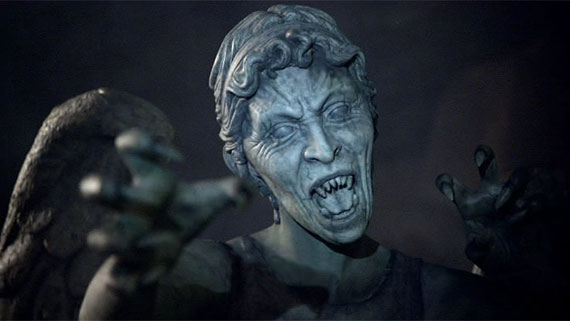
Quick, unspoilery recap for non-fans and to help me focus: The Weeping Angels, quantum-locked assassins that turn to stone if they're observed, and who power themselves by stealing potential (time) energy from their victims by hurling them back into the past, have kicked The Doctor and Martha into 1969 while the TARDIS is in 2007 london. If they can get into the TARDIS, they will have a nearly infinite amount of time juice from which to sup. That would be bad. The Doctor and Martha (as well as two other supporting characters) leave or otherwise deliver long-waiting information to the episode's heroine, Sally Sparrow, who, with the help of her roommate's brother, solve the riddle and save the day.
It's widely recognized as an excellent episode (it won a Hugo, the actress who played Sparrow won an award for for her performance), though it isn't without some early seeds of Steven Moffat's problematic treatment of women (one woman is flatly pursued, Terminator-style, by a young man; another man charmingly objectifies the protagonist). I mention this, not because I think everyone needs to meet an RDA for feminist criticism and patriarchy awareness, but because it touches on the point I'll be making in a moment, if tangentially or orthogonally.
My thesis is not *precisely* unique; my search turned up a near-parallel by a fan on Reddit: http://www.reddit.com/r/doctorwho/comments/12cc98/the_mindblowing_subtext_of_blink/
While that Redditor presents a very compelling Ferris Bueller Thesis ("Life moves pretty fast; if you don't stop and look around once in a while, you might miss it"), it's the final conversation between The Doctor and Sally that casts it in the particular light I'm exploring here, to wit: the Angels are mechanisms for kickstarting a loving life, not ending one.
The Weeping Angels aren't villains at all; they're literally killing with kindness. But don't take my word for it, take The Doctor's:
"Fascinating race, the Weeping Angels. The only psychopaths in the universe to kill you nicely. No mess, no fuss, they just zap you into the past and let you live to death."
What else does The Doctor, Captain Expositionpants hizzownself, have to say about them?
"The Lonely Assassins, that's what they used to be called. No one quite knows where they came from, but they're as old as the Universe, or very nearly. And they have survived this long because they have the most perfect defence system ever evolved. They are Quantum Locked. They don't exist when they are being observed. The moment they are seen by any other living creature they freeze into rock. No choice, it's a fact of their biology. In the sight of any living thing, they literally turn into stone. And you can't kill a stone. Of course, a stone can't kill you either, but then you turn your head away. Then you blink. Then, oh yes, it can. ... That's why they cover their eyes. They're not weeping, they can't risk looking at each other. Their greatest asset is their greatest curse. They can never be seen. Loneliest creatures in the Universe."
Who else turns to stone through observation? Anyone who gazes upon Medusa... but there, it's for her protection. And she is indeed lonely, isolated. As inversions of Medusa, they still share some of her signature traits. To wit:
"Medusa (Greek: Μέδουσα (Médousa), "guardian, protectress") was a monster, a Gorgon, generally described as having the face of a hideous human female with living venomous snakes in place of hair." [Wikipedia] And the Angels fit that description rather aptly, wouldn't you say? Look upon them and they turn to stone. Examine love too closely and it freezes under the weight of an analytical gaze.
Love is scary and unexpected and, convention would have it, comes when you're least looking for it. (Sound like something we're talking about here?) Meta-support for this point is the recurring durability of the Nice Guy trope throughout Moffat's work, which has only gotten more overt in later expressions - standing around near the object of one's desire and making the moves on her will eventually win the lady fair. It happens with Rory and Amy, most notably.
The Angels want the potential time energy of the future, and are willing to give those they steal it from a chance at a full life in the past to get it. Other than losing wi-fi and having to make a fresh start without causing any time paradoxes, this is hardly a bad deal for the victims. Let's see how they fared here.
Item 1: Sally Sparrow's roommate, Kathy Nightingale, gets Angel'd back to 1920, where she meets a young man who does the Terminator thing. "Are you going to keep following me." "Yeah." (The persistence predation thing is one theory of how humans became apex predators. We're not the strongest or the fastest, but we're clever and tenacious, and will simply follow and harass anything delicious until it gives up and we can take what we want, you delicious goddamned mammoth, you. Or we'll chase you off a cliff and let gravity speed things up in our favor... and tenderize you.) They do eventually get married and live, for all intents and purposes, happily ever after. There was no indication that Kathy was in any romantic situation in the present, so, other than the creepy way in which her husband-to-have-been makes his romantic attentions known, she seems to have lived a long and happy life.
Item 2: Detective Inspector Billy Shipton, charming rogue, gets Angel'd back to 1969 after flirting outrageously with Sally (and also not taking "No," for an answer until it turned to "Fine") and doesn't see her again until he's on his deathbed, having spent the intervening years building a facsimile of what, perhaps, he had hoped to have with her - marrying a woman who resembled her and even shared her name.
What really brought this to mind to me was the way the episode closes; The Doctor and Martha are in pursuit of "four things and a lizard," and armed with bows and arrows.
After their exchange, Sally reaches out and takes Larry's hand, rewarding him for having waited patiently in the year that's passed since their encounter with the Weeping Angels and running the video shop together (which, moments before, Sally had pointedly told him that was all they did).
Who is conventionally depicted in statuary, working in the service of love, and armed with a bow and quiver?
Cupid.
Quick, unspoilery recap for non-fans and to help me focus: The Weeping Angels, quantum-locked assassins that turn to stone if they're observed, and who power themselves by stealing potential (time) energy from their victims by hurling them back into the past, have kicked The Doctor and Martha into 1969 while the TARDIS is in 2007 london. If they can get into the TARDIS, they will have a nearly infinite amount of time juice from which to sup. That would be bad. The Doctor and Martha (as well as two other supporting characters) leave or otherwise deliver long-waiting information to the episode's heroine, Sally Sparrow, who, with the help of her roommate's brother, solve the riddle and save the day.
It's widely recognized as an excellent episode (it won a Hugo, the actress who played Sparrow won an award for for her performance), though it isn't without some early seeds of Steven Moffat's problematic treatment of women (one woman is flatly pursued, Terminator-style, by a young man; another man charmingly objectifies the protagonist). I mention this, not because I think everyone needs to meet an RDA for feminist criticism and patriarchy awareness, but because it touches on the point I'll be making in a moment, if tangentially or orthogonally.
My thesis is not *precisely* unique; my search turned up a near-parallel by a fan on Reddit: http://www.reddit.com/r/doctorwho/comments/12cc98/the_mindblowing_subtext_of_blink/
While that Redditor presents a very compelling Ferris Bueller Thesis ("Life moves pretty fast; if you don't stop and look around once in a while, you might miss it"), it's the final conversation between The Doctor and Sally that casts it in the particular light I'm exploring here, to wit: the Angels are mechanisms for kickstarting a loving life, not ending one.
The Weeping Angels aren't villains at all; they're literally killing with kindness. But don't take my word for it, take The Doctor's:
"Fascinating race, the Weeping Angels. The only psychopaths in the universe to kill you nicely. No mess, no fuss, they just zap you into the past and let you live to death."
What else does The Doctor, Captain Expositionpants hizzownself, have to say about them?
"The Lonely Assassins, that's what they used to be called. No one quite knows where they came from, but they're as old as the Universe, or very nearly. And they have survived this long because they have the most perfect defence system ever evolved. They are Quantum Locked. They don't exist when they are being observed. The moment they are seen by any other living creature they freeze into rock. No choice, it's a fact of their biology. In the sight of any living thing, they literally turn into stone. And you can't kill a stone. Of course, a stone can't kill you either, but then you turn your head away. Then you blink. Then, oh yes, it can. ... That's why they cover their eyes. They're not weeping, they can't risk looking at each other. Their greatest asset is their greatest curse. They can never be seen. Loneliest creatures in the Universe."
Who else turns to stone through observation? Anyone who gazes upon Medusa... but there, it's for her protection. And she is indeed lonely, isolated. As inversions of Medusa, they still share some of her signature traits. To wit:
"Medusa (Greek: Μέδουσα (Médousa), "guardian, protectress") was a monster, a Gorgon, generally described as having the face of a hideous human female with living venomous snakes in place of hair." [Wikipedia] And the Angels fit that description rather aptly, wouldn't you say? Look upon them and they turn to stone. Examine love too closely and it freezes under the weight of an analytical gaze.
Love is scary and unexpected and, convention would have it, comes when you're least looking for it. (Sound like something we're talking about here?) Meta-support for this point is the recurring durability of the Nice Guy trope throughout Moffat's work, which has only gotten more overt in later expressions - standing around near the object of one's desire and making the moves on her will eventually win the lady fair. It happens with Rory and Amy, most notably.
The Angels want the potential time energy of the future, and are willing to give those they steal it from a chance at a full life in the past to get it. Other than losing wi-fi and having to make a fresh start without causing any time paradoxes, this is hardly a bad deal for the victims. Let's see how they fared here.
Item 1: Sally Sparrow's roommate, Kathy Nightingale, gets Angel'd back to 1920, where she meets a young man who does the Terminator thing. "Are you going to keep following me." "Yeah." (The persistence predation thing is one theory of how humans became apex predators. We're not the strongest or the fastest, but we're clever and tenacious, and will simply follow and harass anything delicious until it gives up and we can take what we want, you delicious goddamned mammoth, you. Or we'll chase you off a cliff and let gravity speed things up in our favor... and tenderize you.) They do eventually get married and live, for all intents and purposes, happily ever after. There was no indication that Kathy was in any romantic situation in the present, so, other than the creepy way in which her husband-to-have-been makes his romantic attentions known, she seems to have lived a long and happy life.
Item 2: Detective Inspector Billy Shipton, charming rogue, gets Angel'd back to 1969 after flirting outrageously with Sally (and also not taking "No," for an answer until it turned to "Fine") and doesn't see her again until he's on his deathbed, having spent the intervening years building a facsimile of what, perhaps, he had hoped to have with her - marrying a woman who resembled her and even shared her name.
What really brought this to mind to me was the way the episode closes; The Doctor and Martha are in pursuit of "four things and a lizard," and armed with bows and arrows.
After their exchange, Sally reaches out and takes Larry's hand, rewarding him for having waited patiently in the year that's passed since their encounter with the Weeping Angels and running the video shop together (which, moments before, Sally had pointedly told him that was all they did).
Who is conventionally depicted in statuary, working in the service of love, and armed with a bow and quiver?
Cupid.